Death Records in New Jersey can be accessed online in minutes, letting families and professionals retrieve a certified death certificate copy without a long wait. By entering the decedent’s name, date of death, or registration number into the state’s vital records database, users receive instant verification of cause, manner, and medical certification. The portal also guides eligible requesters—spouses, children, legal representatives—through required identification and fee details, ensuring a smooth death record request from the Trenton office.
Death Records searches often reveal hidden hurdles such as name variations, multi‑jurisdiction filing delays, or sealed medical details, but the NJ online system flags these issues and offers clear steps to resolve them. Users can amend errors, request official death certificates, or explore historical records older than 25 years while respecting privacy laws. Quick access to accurate decedent information supports legal, genealogical, and insurance needs, all from a single, secure website.
How to Search Death Records
Death records are official civil records created when a death is registered in New Jersey. A death record search helps a requester locate the registered event and review details such as the decedent’s legal name accessible through official death index records and date and place of death, registration number, cause, and manner of death The New Jersey Department of Health oversees the state office that registers deaths and issues certified death certificates. A search listing or index is only a locator; it is not the same as an official certified copy.
Official Search Portal: https://www.nj.gov/health/vitalrecords/
Steps to Search
- Open the official New Jersey Department of Health page and select the death certificate request service.
- Choose the request method and copy type listed for your needs. Review the current fee and processing estimate before entering details.
- Enter the decedent’s legal name, date of death, and place of death. Add a registration or certificate number if one appears on your records.
- Complete the requester’s contact details, relationship to the decedent, identification, and payment fields. Recent death records require proof of an eligible relationship or another recognized basis for the request.
- Review every field before submitting the request. Save the receipt or confirmation, then follow the delivery instructions. If no record appears, work through the name, date, jurisdiction, and filing checks described below.
Death Record Details and Causes
The details available from a New Jersey death record depend on the record year, filing history, and version of the certificate. An index entry may contain less than a certified copy, and older forms may use different labels. The following fields can help confirm that a search result belongs to the correct person.
Decedent Identity and Registration Number
A reliable match starts with the legal name used for the death registration. Search results can also be separated by comparing birth facts, event facts, family links, and the state registration number. A registration number is the strongest identifier when it is available, so retain it with any supporting papers.
Immediate Family and Eligible Requesters
New Jersey limits who may obtain a certified death certificate for a death that occurred less than 25 years ago. Eligible categories include a spouse, child, parent, sibling, grandparent, grandchild, legal representative, and a person with a demonstrable financial interest in the death. Government agencies may request records when the request falls within their official duties. An attorney, agent, funeral representative, or other professional can act for an eligible person when the request shows that authority.
The applicant must complete the eligibility portion of the current request form and provide documents that support the stated relationship or interest. The Office may request a certified court document, an adoption record, a marriage or divorce record, or another listed source. A general interest in family history, curiosity, or a business purpose without a recognized tie to the death does not by itself qualify a request for a recent record.
Identity checks apply to both family members and professional requesters. The requester should use the identification and payment methods stated for the selected request channel. If another person handles the request, the Office may need both the requester’s authority and the qualifying person’s eligibility.
Cause, Manner, and Medical Certification
Cause of death describes the disease, injury, or other sequence of conditions leading to death. A certificate may place the immediate cause in one field and the underlying cause in another, with other significant conditions and the time intervals between them. These entries explain the medical chain reported to the state.
Manner of death classifies how the death occurred. The standard categories include natural, accident, suicide, homicide, undetermined, and pending. Manner is separate from cause: a natural death can result from a disease, while an accident can involve an injury with a specific medical cause.
A physician certifies many deaths. A medical examiner or coroner handles deaths that fall within investigative requirements and may certify the cause and manner after reviewing medical, law enforcement, or scene facts. A pending entry means the medical conclusion was not yet complete when the certificate was signed. A later amendment may be issued after the responsible medical authority supplies the final certification.
Official Certificates and Amendments
A New Jersey certified death certificate is the official state copy of the registered death event. The request process includes record matching, eligibility review, payment, and document preparation. Choosing the correct copy type and supplying accurate documents prevents delays at each stage.
Certified Copies and Other Request Options
The current order page may present more than one document option. Review the labels there before paying. A locator, research copy, or receipt can serve a limited purpose, but none carries the same legal effect as a certified death certificate.
Ask the agency receiving the record which version it requires. A court, insurance company, pension plan, or benefits office may ask for a certified copy even when a research copy would meet a family-history need.
Required Identification, Fees, and Processing Time
A complete request normally contains the decedent’s details, the applicant’s full name and contact information, the relationship or other eligibility basis, a signature, and payment. The request form may ask for a government-issued photo identification and proof of relationship or authority. Mail and in-person requests may require a photocopy of the listed documents, so applicants should follow the exact instructions for their chosen method.
The fee can vary by copy type, request channel, and delivery choice. Rush handling, shipping, or a payment service may carry separate charges. New Jersey’s live request form and official checkout show the current state fee, accepted payment methods, and any service or delivery charges. Older articles and third-party fee totals may differ, so use the amount displayed in the official request workflow.
Death certificate processing time also depends on the request method and delivery choice. The published estimate begins from a complete, paid request that has passed the required identity or eligibility review. An applicant should save the confirmation and watch for status or delivery notices. A receipt shows payment was accepted, but it does not show that the certificate has been issued.
Correcting Errors and Submitting Amendments
Ordering another ordinary copy does not correct an error. A record that contains an incorrect name, date, place of death, relationship, cause, or manner requires the separate correction process shown on the official death certificate page. The correction application should identify the exact field and describe the proper value.
Supporting documents must match the type of change. A legal-name correction normally requires a certified court order or another accepted legal record. A change to a date or place of death requires a source record that supports the correction. Changes involving cause or manner must come from the physician, medical examiner, coroner, or other responsible certifier. A personal note without official support cannot change those medical entries.
The Office reviews the application and supporting evidence. Medical amendments may require review by the original certifier or the medical authority currently responsible for the case. If the evidence supports the change, the state issues a corrected certified copy rather than an altered document. If the request lacks support, the Office may reject it or request additional records.
Public Availability and Confidentiality
New Jersey balances family needs, legal use, and personal privacy in its vital-record rules. The public availability of a death certificate depends chiefly on the date of death, the requester’s eligibility, and the type of record held. Medical examiner files, court-sealed records, and other agency documents can have separate rules.
The 25-Year Public Availability Rule
Under New Jersey’s 25-year rule, a death record is generally restricted until 25 years after the date of death. During that period, certified copies are available to eligible family members, legal representatives, people with a demonstrable financial interest, and qualifying government agencies. The requester must show the basis for the request using the evidence listed by the Office.
Once 25 years have passed since the death, the record may be requested without a family relationship. Identification, payment, and ordinary request rules still apply. Public availability of the civil death record does not by itself make every related medical, investigative, or court file available to the public.
Confidential Medical and Sealed Record Details
Cause and manner of death can be sensitive facts within a recent death record. An eligible applicant may receive them on a certified copy accessible through official obituary records databases and while a public search listing may show only basic facts or omit the medical fields A pending cause appears as an incomplete medical conclusion and may later change through a certified amendment.
Some records may also be subject to a court order or another legal restriction. A requester with a sealed order should provide it when the Office asks for proof of the restriction or the basis for disclosure. A general family relationship does not override a specific court directive.
Medical examiner and coroner materials are separate from the civil registration file. Their release can depend on the agency’s own rules, the purpose of the request, and the type of record sought. A public death certificate request should not be treated as a request for the complete investigative case.
Retrieving Historical Death Records
New Jersey began statewide registration in 1873, but archive coverage varies by year and collection. Older entries may sit in the New Jersey State Archives, county collections, or local records instead of the current online request system. An older index may also list only a surname, year, and registration reference, leaving the full entry to be obtained from the source collection.
- For a death registered in New Jersey, use the state death certificate request service when the event falls within the Office’s registered collection.
- For a death that occurred in another state, request the certified record from the jurisdiction where the death occurred. A New Jersey resident index may list the event without making it a New Jersey-certified death.
- For older local or archival entries, use the New Jersey State Archives or the holding county or local office to locate the source. A certified copy must come from the custodian of that record.
- For an index entry without a readable certificate, treat the index as a locator. It can supply the date, name, county, or registration reference needed for the next request.
Record Accuracy and Resolution
A missing or mismatched result does not always mean the death was never registered. Names, dates, filing paths, and source collections can create gaps in a search. A careful comparison of each available clue gives the Office the best chance to locate the right record without exposing private details to the wrong person.
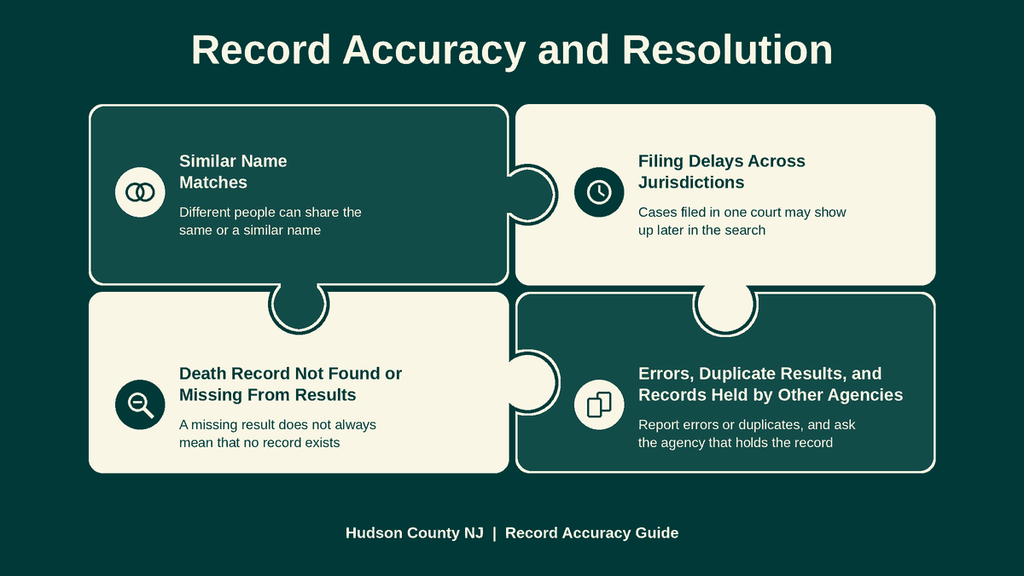
Similar Name Matches
Search by the full legal name recorded at death, including middle names, prefixes, and suffixes when known. A hyphenation difference, omitted middle name, married surname, or informal family name can create an extra result. Searching several reasonable name forms is more useful than guessing which one the state used.
Compare each match by date of birth, age, date and place of death, sex, parents, spouse, and registration number. The registration number is the clearest way to separate two people with similar names. For a death less than 25 years old, perform this comparison within the authorized request view to avoid viewing or sharing protected details.
Filing Delays Across Jurisdictions
A death is reported locally and then moves through state registration. The local registrar or county office may accept the report before the state office assigns or posts the registration details. Medical examiner or coroner review can add time, particularly when the cause remains pending or the certificate needs medical amendment.
The place of death controls the event jurisdiction. A New Jersey resident who dies in another state may need that other state’s certificate. A visitor who dies in New Jersey may have a New Jersey record even though the person’s residence and family records are elsewhere. Residence-based indexes can therefore create the appearance of a missing event.
Death Record Not Found or Missing From Results
Begin with the jurisdiction where the death occurred, then confirm the date and the legal name. Check a one-digit date entry error, a transposed year, an omitted middle name, and the spelling used by the local funeral home or medical examiner. A registration number can remove most ambiguity.
Check whether the event belongs to an older archival collection rather than the current request system. Recent deaths may lack a posted result while registration, identity review, or medical certification is still pending. A database search also cannot locate a record that was never registered in the jurisdiction being searched.
If the facts remain unresolved, submit the requester’s strongest identifiers and ask the Office to trace the registration. Follow its request for proof of the death, relationship, identity, or supporting civil record. Cemetery receipts, obituaries, and funeral-program details may help identify the event, yet they do not act as certified death records on their own.
Errors, Duplicate Results, and Records Held by Other Agencies
Duplicate listings can occur when an index contains several filings for the same event or when a correction creates a new reference. Compare the registration number and corrected fields before treating two entries as separate deaths. The Office can confirm whether an apparent duplicate is a prior version, an amended record, or a separate event.
Other agencies may hold related records. A local registrar may retain a filing copy, a county office may have an index, a probate court may hold estate documents, and a cemetery may hold burial facts. A coroner or medical examiner may hold the investigative file. None of those records substitutes for a certified New Jersey death certificate.
When a court order changes a fact that appears on the certificate, submit the certified order through the correction process. The court file proves the legal change; the state office updates the civil registration record. This separation explains why a court document can exist without the corrected fact appearing in an online death record.
Compare Death Records With Related Sources
Several records can mention the same person, yet each answers a different question. Use the source that matches the task and check dates and identifiers before drawing a conclusion.
Differences among these sources do not automatically prove that one record is wrong. Match each entry by legal name, event date, place, and registration references. An older certificate may also use different terminology from a current record without creating a factual conflict.
Choosing and Using the Right Death Certificate
The record that meets a family-history need may not meet a legal requirement. Start with the purpose of the request, check the receiving agency’s rules, and choose the state-certified copy when official acceptance is required.
When to Order a Certified Copy
Estate administration, insurance claims, benefit programs, pension accounts, court matters, and some financial transactions can require a certified death certificate. Ask the receiving office whether it needs an original, a certified copy, a photocopy, or a certified copy sent directly. Requirements vary by recipient, so a copy accepted by one agency may not satisfy another.
A non-certified research copy is suitable for private family-history work when the recipient accepts that format. An index listing can help locate older records, and an order receipt can document the request, but neither replaces an official certified copy for legal use.
Keeping a Request Accurate and Secure
Review the legal name, date of death, place of death, and registration number before payment. A precise request reduces the chance that the Office must contact you for clarification. Record the request method, fee paid, confirmation number, and expected delivery date in one place.
Use the official state page or its state-linked checkout. Look-alike commercial sites may carry higher service fees or use unclear request terms. A certified death certificate contains sensitive identity facts, so keep full images and registration numbers out of public posts and shared message groups unless there is a clear need.
Contact Details
Use the following details for certified death certificate requests, correction forms, and unresolved record questions. Keep the decedent’s registration number and request details ready when contacting the office. Include the date of death and any relevant supporting documents if required. Check the applicable eligibility rules, identification requirements, and processing fees before submitting a request. Contact the responsible records office for clarification if an application is incomplete or additional information is needed.
Frequently Asked Questions
Death records give legal proof of a person’s passing and include vital details such as name, date, place, cause, and registration number. Accessing these records helps families settle estates, verify identity, and research genealogy. The New Jersey Department of Health manages official death certificates and offers online tools for quick searches or formal requests.
How can I search death records online in New Jersey?
Visit the New Jersey Department of Health website and select the “Death Records Lookup” link. Enter the decedent’s full name, date of death, or registration number. The system returns a list of matching entries with basic information. Click a result to view the record summary and request a certified copy. Online searches are free, but a fee applies for the certificate.
What steps are needed to request a certified death certificate?
Download the death certificate request form from the state health page. Fill in the decedent’s name, date of birth, and death details. Attach a valid photo ID and proof of relationship if required. Mail the form with the $15 fee to the Trenton office or submit it in person during business hours. Processing usually takes 7‑10 business days.
Can I get a death record by name if I only know the month of death?
Yes. Use the “Search by Name” option and leave the date fields blank or enter the month range. The database matches any record with that name within the selected month. Review each match to confirm the correct individual before ordering a copy. This method works for recent and historical records.
What fees apply for a death record copy and how are they paid?
The standard fee for a certified death certificate is $15. For expedited service, an extra $10 is added. Payments can be made by check, money order, or credit card when ordering online. If you apply by mail, include a check or money order payable to the New Jersey Department of Health.
Who is allowed to request a death certificate in New Jersey?
Immediate family members, legal representatives, and anyone with a documented need such as a court case or insurance claim can request a death certificate. Proof of relationship or legal authority must be shown, typically through a driver’s license, passport, or power of attorney. Unrelated individuals may obtain only a non‑certified copy for research.
Why might a death record be delayed or missing from the database?
Delays occur when the death is still being processed by a medical examiner or when the registrar has not entered the data. In rare cases, records are sealed for ongoing investigations or privacy concerns. If a record does not appear after two weeks, contact the Vital Statistics office at 877‑622‑7549 for status updates.