Background Check by name and date of birth lets you tap into New Jersey State Police’s State Bureau of Identification records, revealing arrest logs, court filings, and vital data in minutes. This fast NJ state police lookup pulls misdemeanor, felony, and sentencing details, plus civil dockets and property filings, so you can verify identity without waiting for delayed multi‑jurisdiction reports. By using a public records background check you gain the clarity needed for hiring, tenant screening, or personal safety.
Background Check services combine a background screening with an online public records search, delivering a concise background information report that respects permissible use and consent rules. Whether you need a background check by address, county, or state, the system highlights sealed or expunged exclusions and guides you on correcting inaccurate files. This authoritative yet approachable tool helps you meet legal compliance while uncovering the essential history behind any identity.
How to Search Background Check
A Background Check for a New Jersey person can locate a fingerprint-based criminal history maintained by the New Jersey State Police, State Bureau of Identification. The result may show reported arrests including verified hudson county resources and convictions, sentences, and case dispositions, with completeness tied to fingerprinting and agency reporting Civil cases, judgments, property filings, business filings, marriage records, and birth or death records come from separate court and government offices. The purpose is to match verified identity data to each proper source and review the result under applicable screening law.
Official Search Portal: https://www.nj.gov/njsp/division/administration/identification-information-technology.shtml
Steps to Search
- Open the official State Police page and locate the State Bureau of Identification area for criminal history record requests.
- Use the current request form linked on that page. Enter the legal name, date of birth, and former names when the form asks for them.
- Complete the purpose and identity sections, sign where requested, and include the payment or supporting documents required by the current form.
- Send the request using the delivery method stated on the form and allow the processing period shown by the State Police.
- Review each match against verified identity details, then request case-level records from the court or county office when a decision depends on the full file.
Background Record Search by Source
The New Jersey State Police page is the official starting point for a State criminal history record. The State Bureau of Identification, or SBI, maintains the statewide repository described by the agency. It is not a live search of every court, county, business, or life-event file in New Jersey. A search by name and date of birth fits the criminal-history request; address, county, state, and document type fit other public offices.
Claims of an instant, all-records lookup need care. A public records background check may place several source records on one screen, but it does not make one agency the custodian of every result. Verify each claim with the office that created or holds the record. An online background check page can organize data, yet the source agency remains the authority for the underlying file.
Date of birth is a strong matching field, yet it is not the only check. Names can change, and a search may return records under an old legal name. Former names, middle names, addresses, case numbers, and dates can help separate two people with similar names. An address search works for property and tax records, but it cannot prove that a person living there is the person named in a criminal file.
Criminal, Court, and Life-Event Records
Criminal, court, and life-event files answer different questions. The State criminal history record connects a fingerprint event with reported arrests and case outcomes. A court file explains the charges, pleadings, evidence, hearing history, and judgment. County offices hold property, business, or marriage records that are not part of a criminal-history request. Keeping these sources separate prevents a public entry from being mistaken for a conviction or a sign that one person committed an act.
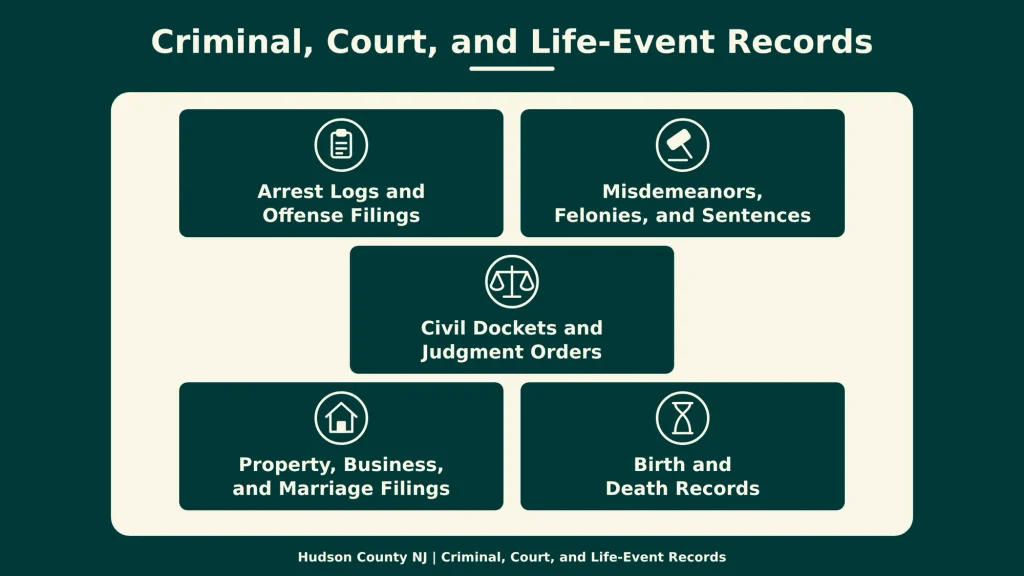
Arrest Logs and Offense Filings
An arrest entry records that law enforcement took custody; it does not by itself prove guilt or a conviction. The later disposition can show dismissal, acquittal, a plea, conviction, or another court outcome. Read the date of each event so an arrest from one year is not linked with a disposition from another case.
The State Police result can connect a reported arrest with the outcome reported by the court. It may not contain every complaint, affidavit, witness statement, exhibit, or hearing transcript. A case that was never fingerprinted may also be absent from the repository. Use the court docket for the full case file and match it by case number rather than by name alone.
Misdemeanors, Felonies, and Sentences
New Jersey law distinguishes misdemeanors, felonies, and municipal ordinance violations, yet a database label is not a substitute for the charging document or judgment. Read the offense description, charge, plea or disposition, and sentence together. A person arrested for one offense may have that charge reduced, dismissed, or resolved in a way that differs from the initial arrest entry.
A sentence field may show terms ordered by the court. Later events, such as a sentence change, completion, or expungement, may affect how the case appears in a current request. Ask the court for the latest judgment and ask the State Police whether its record has received that source update. The court judgment controls the legal outcome shown by the case.
Civil Dockets and Judgment Orders
Civil dockets list noncriminal disputes, such as contract claims, property claims, judgments, and post-judgment cases. They come from the New Jersey court system rather than SBI. Search by county, case type, party name, or case number as the court permits. A docket line can show the case status without every supporting paper.
Judgment orders and satisfaction documents may require a separate request even when a case appears online. Some court records are public, some are limited by the court’s rules, and some documents carry a filing fee. For a decision that depends on the exact wording of a judgment, request the official court copy and confirm its status with the clerk’s office.
Property, Business, and Marriage Filings
Property and tax records come from county offices. A deed can show a transfer of ownership, while a tax assessment reflects the assessor’s listed value and does not prove the amount paid in a sale. Business entity filings come from the New Jersey Division of Revenue and Enterprise Services. They show an entity’s filed records, not the personal identity of every owner or officer.
Marriage indexes and certificates are handled by the county surrogate or probate office. A county search by address may point to property or marriage indexes, but it does not create a criminal-history match. Each result needs its own source, date, and document number before it belongs in a screening or personal review.
Birth and Death Records
Birth and death records are handled through the New Jersey Department of Health’s record process and sit outside SBI’s criminal repository. A birth or death index may confirm an event and date without showing every family detail. When a certified event copy is needed, request it through the authorized state or local process. Do not merge a life-event record into a criminal profile unless a verified source shows a direct connection.
Legal Compliance and Consumer Rights
A public-record search and a consumer report serve different legal functions. Under the federal Fair Credit Reporting Act, 15 U.S.C. § 1681 et seq., a consumer report is a record about a consumer that a consumer reporting agency furnishes for an eligibility decision involving employment, housing, credit, insurance, or another covered purpose. State law and local fair-housing rules can add duties. A party that searches records for its own decision may fall outside the federal consumer-report definition, so the search method must be classified before legal duties are assigned.
Permissible Use and Screening Laws
The Fair Credit Reporting Act limits who may request a consumer report and why. A hiring, housing, credit, or insurance decision cannot use a consumer report without a lawful purpose and the required notice to the person screened. New Jersey’s Fair Credit Reporting Act, N.J.S.A. 56:11-31 et seq., operates with the federal law. New Jersey’s Fair Chance to Compete Act, N.J.S.A. 27:11-34 et seq., also restricts the timing of criminal-history screening for covered employers, subject to current job-category exceptions.
Do not treat a public record as fair to use merely because it appears online. Screening rules can depend on the industry, job, housing type, record type, and stage of the process. A legal review should use the current statute text and the official agency instructions for the specific use rather than a promise made by a private search page.
Authorization Rules for Consumer Reports
For most employment consumer reports, the employer must give the applicant a clear disclosure and obtain written authorization before the report is ordered. A specific federal exception can replace that step for a covered situation accessible through official people search portals and but the exception must fit the actual facts Consent to one report does not automatically cover another report, a different purpose, or a later reassessment.
The person screened should read the disclosure and authorization before signing. It should identify the type of consumer report, the intended use, the relevant user, and the certification requested by the employer. If the document lacks a clear purpose or appears to cover an indefinite period, ask the employer or consumer reporting agency to correct it before proceeding.
Official Record Correction Rights
Before an adverse decision based on a consumer report, the user must give the person a copy of the report and an adverse action notice. The notice must state that the consumer reporting agency did not make the decision, identify the agency’s contact details, and explain the right to dispute accuracy and request a free copy. A dispute sent to the consumer reporting agency within 60 days after the copy is received can trigger a free reinvestigation and written results.
A dispute and an official-record correction are related but separate. The consumer reporting agency handles the consumer dispute; the court or state agency handles the source record. If a court entry is wrong, seek correction from that court. If the State Police result conflicts with a proven court outcome, follow the correction instructions on the State Police page or request correction instructions from SBI, and attach the source documents. A private site cannot remove an error from an official file.
A sound screening file should retain the disclosure, authorization, report receipt, dispute, and decision date. Keep proof of notice delivery separate from the decision record so the sequence of required steps remains clear. A state agency’s correction of a source file does not replace a consumer reporting agency’s duties to the person screened.
Public Availability and Official Copies
Public availability depends on the office and record type. The State Police request process, court docket rules, county copy rules, and state registry rules each govern a different record. A search result, an ordinary copy, and a certified copy serve different purposes and should not be treated as interchangeable.
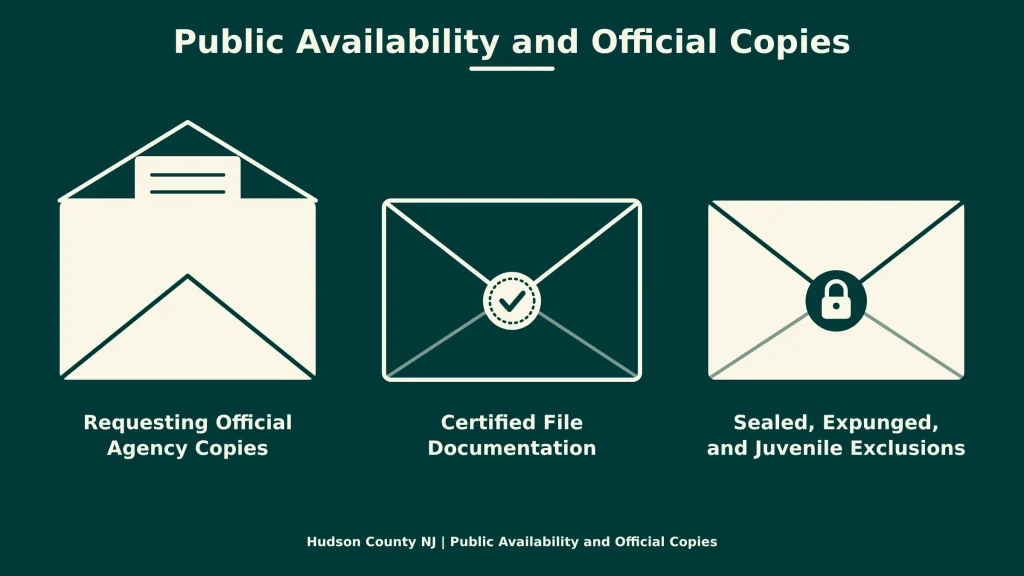
Requesting Official Agency Copies
Use the current SBI request form linked from the official State Police page. Match the legal name and date of birth to source documents, complete every required purpose field, and sign the request. Add the payment and supporting papers only as the current form directs. If a vendor sends the request on your behalf, confirm that the packet still follows the State Police process shown on the official page.
For court records, first identify the county, court, and case number. County clerk, surrogate, tax, and business offices may require different identity checks, request forms, fees, or proof of party status. Their rules differ, so do not carry a fee or eligibility rule from one office to another. Record the date sent, payment method, request number, and the office that received it.
Certified File Documentation
A certified copy is a copy authenticated by the office that holds the original record. Certification may include a seal, signature, or statement that the document is a true copy. A search result, screen capture, or third-party background report may lack that authentication. Ask the issuing office whether it certifies that record type before treating it as an official certified document.
For a court judgment, start with the clerk of the court that handled the case. Recorded property documents come from the county clerk or registrar, recorded marriage documents from the county surrogate, business filings from the Division of Revenue and Enterprise Services, and birth or death certificates from the New Jersey Department of Health. The State Police page controls the form and available copy options for a State criminal history record.
Sealed, Expunged, and Juvenile Exclusions
Sealed records are closed by court order or statutory rule and do not belong in an ordinary public search. Expungement is different: under New Jersey’s Criminal History Record Information Expungement Act, N.J.S.A. 2A:164-1 et seq., a qualifying court order can remove eligible arrest and conviction entries from the State criminal-history record. An expunged event may no longer appear in a later SBI result. The New Jersey Attorney General’s expungement process handles that legal change; a private search page cannot order it.
Juvenile records have separate confidentiality rules and are not part of an ordinary adult criminal-history request. Access can arise when a juvenile matter was certified to adult court or through a specific court process, depending on the law and case. A result showing no adult record cannot be read as proof that no arrest or court action occurred at any age. It can only describe what the responding repository reports for the requested category.
Record Accuracy and Resolution
A background check is an identity-matching task as much as a record search. The result can be wrong because a source was reported with bad identifiers, because a private site merged two people, or because one repository does not receive a filing made elsewhere. Correcting the match requires a source-by-source review.
Similar Name Matches
A shared name is weak proof. Compare date of birth, middle name, former names, address history, case number, offense dates, and disposition. Two people may share a full name and birth date; court records can still separate them through addresses or case numbers. Treat any one field as supporting data rather than proof.
Address history is useful only with care. People share homes, change addresses, and move after a case. Use address to distinguish possible matches, not to accuse or reject a person. If a legal name changed, attach the official name-change record to a correction request so the source agency can match the old and new names.
Multi-Jurisdiction Reporting Delay
The New Jersey repository does not replace a national search. A federal case, a conviction from another state, a county civil judgment, and an uncounted municipal case can each sit outside it. Reporting can also lag behind a court event, especially when fingerprints, dispositions, or update requests reach the State Police late. Some cases were never fingerprinted, so no amount of waiting creates an entry at SBI.
A New Jersey address does not make every record in another state part of the State Police result. A person can move, be arrested elsewhere, return, and receive a New Jersey fingerprint record that does not include the other case. Request records from the court or state agency in the place where the event occurred. For a multi-jurisdiction report, keep each jurisdiction’s case number and certified result separate.
Unlisted Background File Resolution
If an expected record is missing, identify the record type before contacting an office. A civil judgment belongs with the court. A New Jersey arrest or sentence belongs with the SBI request process. A federal or out-of-state case belongs with the court or agency in that place. Property, business, marriage, birth, and death events each have a named custodian. This step prevents a request from being sent to an office that cannot hold the missing file.
- Recheck the legal name, date of birth, former names, county, state, and case or document number against the source.
- Ask the court for a dated docket entry and official copy when the case number is known.
- Request a current State criminal history record through the State Police form when the event involved New Jersey fingerprints.
- Send a written correction request to the agency or court that holds the source record, with the official document attached.
- Use the consumer reporting agency’s dispute process for an error in a consumer report, even if a source-record correction is already underway.
Keep a resolution log with the request date, source office, reference number, person contacted, documents sent, and result received. If the source confirms no filing, record that result with its date. If a correction changes a name, charge, disposition, or sentence, obtain the updated record and replace the earlier result.
Contact Details
Use these official details for a New Jersey State Police criminal history record request and for questions directed to the State Bureau of Identification. The bureau handles criminal history record inquiries and related identification services. Review the applicable request requirements, fees, and processing instructions before submitting an application. Contact the department directly for clarification about record availability, fingerprinting procedures, or request status.
Frequently Asked Questions
Background check services let you verify a person’s criminal history, civil records, and identity details. In New Jersey, the State Police maintains fingerprint‑based data that employers, landlords, and individuals can access. Knowing how to request a background check, what information appears, and how to interpret results helps protect safety and make informed decisions.
What does a New Jersey background check include?
A New Jersey background check pulls criminal history from the State Bureau of Identification. The report lists arrests, convictions, sentences, and case outcomes that were reported with fingerprints. It also shows civil judgments, property liens, and business filings when available. Data comes from courts, law enforcement, and state agencies, giving a full picture of a person’s legal background.
How can I run a background check by name or date of birth?
Start by visiting the New Jersey State Police website or contacting their identification division. Submit the full name and date of birth, then pay the required fee. The agency matches the input with its records and returns a report within a few business days. Accuracy improves when you include middle initials or exact birth dates.
Can I perform a background check online for free?
Free online searches may show limited public records, such as marriage or property data. For a complete background check, including fingerprint‑based criminal history, you must use the official state portal or an accredited screening company. These services charge a fee but guarantee up‑to‑date and legally compliant results.
What steps should I follow to verify a background check record?
First, obtain the report from the State Police or a licensed provider. Second, compare the listed arrests and convictions with court docket numbers. Third, contact the court clerk to confirm case outcomes. Finally, keep a copy of the verification for your records. Following these steps reduces errors and protects against false claims.
How does a background check help landlords screen tenants?
Landlords use background checks to confirm that prospective renters have no violent or property‑related convictions. The report also reveals unpaid judgments or bankruptcies that could affect rent payments. By reviewing this data before signing a lease, landlords lower the risk of costly evictions and maintain a safe community.