Active Warrants can appear unexpectedly, leaving individuals unsure how to confirm their legal standing. An instant active warrant search by name or case number pulls up up-to-date active warrants records from the Hudson County Sheriff, showing clear warrant status and outstanding warrant lookup results. By using the online warrant database you can verify whether a warrant is still active, locate the warrant number, and plan next steps with confidence.
Active Warrants also affect employment background checks and can be served across state lines, so understanding the warrant lookup by name and warrant search by warrant number is crucial. Check the warrant status find field for “active” and contact the issuing court for verification. The public warrant record search is free, and the Hudson County Sheriff’s office confirms any discrepancies in the warrant records check before you take legal action.
How to Search Active Warrants
Active warrants are court-issued orders that can remain outstanding until the issuing court recalls, quashes, or otherwise resolves them. An active warrant search by name, case number, or warrant number helps a reader locate a record held by the hudson county Sheriff’s Office and read the status shown on the official page. The purpose is to identify a possible match, confirm the issuing court and identifiers, and determine what response the court requires. A public lookup does not replace confirmation with the Sheriff’s Office or the court that issued the warrant, especially when a record is new, recently closed, sealed, or tied to a name shared by several people.
Official Search Portal: https://www.hudsoncountysheriff.org/
Steps to Search
- Open the official Hudson County Sheriff’s Office website and use its navigation to reach the section for warrant searches or public records.
- Enter the most exact search term you have. A warrant number or case number can narrow the result, while a name search may show several people with similar names.
- Review each match for the full name, warrant number, case number, warrant type, issuing court, and displayed status. Compare those details with court papers or notices.
- Check whether the result shows a next appearance date, recall, quash, clearance, or other disposition. Keep the exact wording shown on the page for later reference.
- If the result is new, unclear, or disputed, contact the Sheriff’s Office or the court listed on the record for current status. Note the date of the lookup and the response received.
Search pages are snapshots, and the agency may update them after a court action. A result marked active should be treated as a prompt for verification, not a substitute for a court appearance or legal advice. A page with no match does not prove that no warrant exists; it may mean the query used the wrong identifier, the record is restricted, or the update has not reached the page.
Details to Have Ready Before Verification
Having the correct identifiers prevents a search from returning a namesake or a different case. Prepare only the details requested by the official search page, then keep any notice or court paper with the same case reference. These details also help a court clerk locate the file without repeating the search.
- Full legal name, including any middle name, initial, suffix, or former name shown on court papers.
- Case number exactly as printed, including letters and any suffix.
- Warrant number from the warrant, notice, or court filing.
- Issuing court and the location listed for that court.
- Date of birth or address only when the official form requests it. Avoid sending these details to an unofficial site.
- Appearance date, missed date, or condition listed on a failure-to-appear notice, summons, or other order.
- Copies of any notice, appearance confirmation, payment receipt, or written order showing what was filed with the court.
- A written note of each search, including the date, search terms used, result displayed, and any reference number.
The public warrant record search is free through the official source. A third-party site may present an older copy or a separate service, so check the agency name, court, and case details before relying on its result.
Classifications of Active Warrants
Warrant labels describe how a court record is categorized or how the order arose. They do not prove the merits of the underlying case, and a label alone does not show whether the order has ended. The active warrant lookup should be read with the case number, issuing court, status, and disposition fields.
Bench Warrants and Failure-to-Appear Notices
A bench warrant is commonly tied to a missed appearance or failure to follow a court instruction. It can also arise from another violation of a court order. A failure-to-appear notice may tell a person to appear; it does not, by itself, show whether a warrant has been entered. Read the document and search result together. The case number, missed date, and issuing court should agree before treating the notice as a bench-warrant record.
A notice may ask for a response before a warrant is issued, or it may refer to a warrant that already exists. The wording and issuing court matter. If the notice gives a new appearance date, confirm that date with the court rather than relying on the notice alone or on a search-page entry.
Misdemeanor and Felony Warrant Classifications
A misdemeanor warrant relates to a charge or court matter classified at the misdemeanor level. A felony warrant relates to a felony-level matter. The classification does not mean the person has been convicted. It also does not identify the appearance date, bond conditions, or whether the warrant has been recalled. Read the charge description, case number, court, and status together. If the search result names a case from another county or state, identify that court before seeking a local response.
Why the Charge Level Does Not Establish Current Status
The felony or misdemeanor label describes the court matter named in the warrant, not the person’s guilt or the current status. A warrant may exist before a case has been decided. Its status can change through a court order, so use the case number and disposition fields to decide which court must confirm the record.
The wording on a public page can vary across records and search updates. The charge level does not decide how soon a person must respond, and a status label does not describe every obligation from the case. Use the issuing court as the source for the next required step.
Steps to Take Regarding an Active Warrant
A search result creates a response decision, not a legal conclusion. If the official page shows an active warrant, the safest path is to identify the issuing court, seek legal counsel, and follow the court’s stated process. Do not ignore a record because it appears online, and do not assume a call to a non-issuing office ends the matter. An online search can locate a warrant record; it cannot recall, quash, or clear the order.
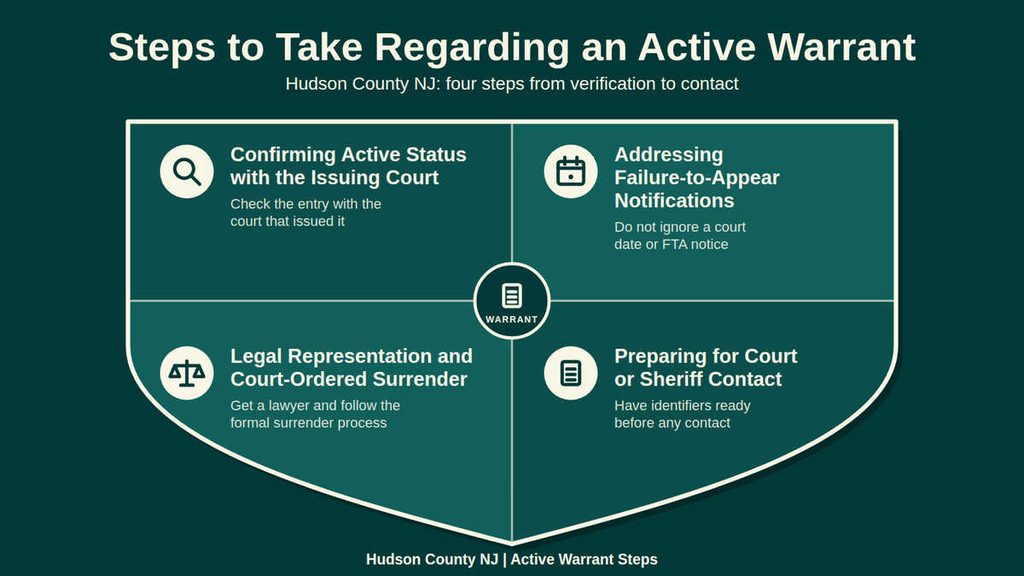
Confirming Active Status with the Issuing Court
The issuing court controls whether a warrant remains open. The Sheriff’s Office can confirm the record it holds and the status it can verify, while the court can confirm the docket action. Ask for the exact warrant number, case number, status, and next appearance date. Ask whether the court requires a personal appearance, a response through an attorney, or another listed step. A clerk can provide procedural facts and identify missing paperwork; legal advice about the case belongs with a licensed attorney.
An active record can be handled outside Hudson County. The issuing order and applicable law govern what another agency may do, so a person should not assume that living in another city or state makes the record inactive. Confirm the status with the court before making travel plans or treating the warrant as resolved.
Addressing Failure-to-Appear Notifications
A failure-to-appear notice is time-sensitive. Read it for the court, date, reason, and required response, then contact the court or an attorney if the date has passed or the wording is unclear. Do not assume a web result shows that referencing verified warrant records databases and an appearance has been credited A missed appearance can lead to a bench warrant or other court action, depending on the order and applicable law. Get the current court position before the next hearing or appointment.
If a clerk says no warrant is active, ask what record shows the earlier appearance and whether the notice was resolved. If a warrant was entered, ask for the case number and the next required step. Keep the response with the notice so both documents show the same case history.
Legal Representation and Court-Ordered Surrender
If an official page shows an active warrant, contact a licensed attorney who handles New Jersey criminal matters. An attorney can review the charge, identify the response allowed by the order, and coordinate any required appearance or surrender with the court and Sheriff’s Office. The office can answer questions about its own process, but it cannot replace advice on the defense or the legal effect of the charge.
When a court orders surrender, follow the written instructions, confirm where and when to appear, and ask what documents or payment are required. Do not treat a phone call as proof that the warrant has been cleared unless the court confirms that exact result. Keep proof of any appearance, filing, or release instruction.
Preparing for Court or Sheriff Contact
Before calling, write down the name shown on the warrant, case number, warrant number, issuing court, and any appearance date. Have the notice and related papers ready. State the exact question: whether the record is active, whether it was recalled or quashed, what appearance is required, or what action the Sheriff’s Office can confirm. Ask for a reference number and written confirmation when available. A clear record of the contact can prevent two offices from giving conflicting details.
What a Warrant Search Result Can Show
An official lookup result is most useful when read as a set of linked fields rather than a single word such as active. The agency page may display only some fields, and exact labels can change as the page is updated. Treat every field as a clue to the court record that needs confirmation.
An active label means the agency page presents the record as outstanding. It does not replace the issuing court’s current docket, especially if a recall happened after the last update. A public warrant lookup and an employer background check are separate processes, so a result on one page does not predict the other.
Record Accuracy and Resolution
Warrant records change through court orders, recalls, quashes, dispositions, and service updates. A search page can lag behind those actions, and some records are not displayed. Accuracy issues should be handled with source checks rather than an assumption that the search page has made an error.
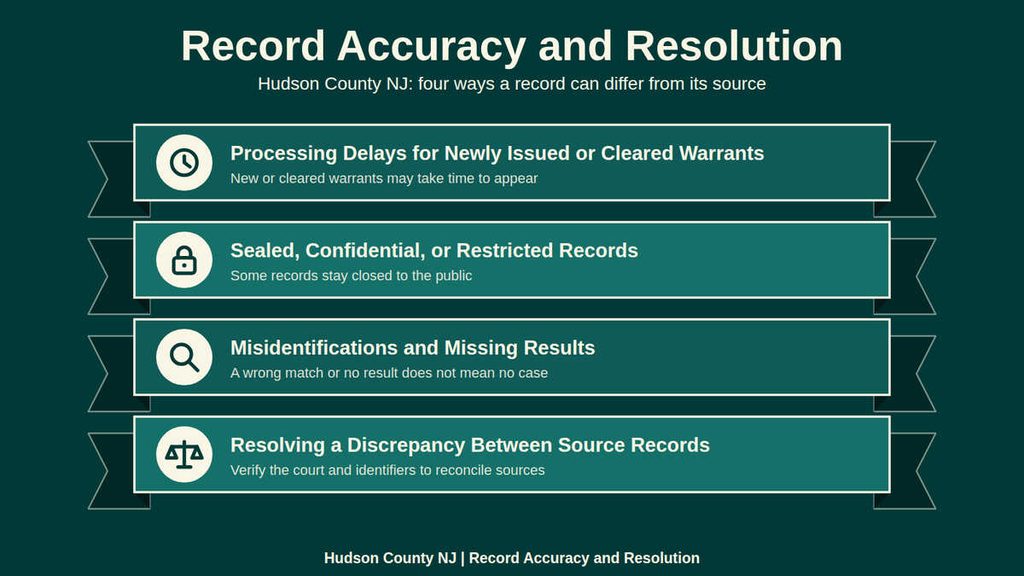
Processing Delays for Newly Issued or Cleared Warrants
A warrant may be entered by the court before it reaches the agency’s search page. The same delay can affect a record after a recall or quash, leaving a closed order visible for a time. The page can also show a record before every field has been updated. Do not assign a fixed update interval unless the agency states one. Treat any recent change as needing confirmation from the issuing court.
If a court date, recall, or disposition occurred recently, check the court docket and contact the issuing clerk if the agency result conflicts. Record the date of each check rather than relying on memory. A discrepancy in one field does not prove that the whole case is wrong; it may reflect an outdated field or a different case sharing the same name.
Sealed, Confidential, or Restricted Records
Some case records can be sealed or limited by court rules, confidentiality orders, or the type of proceeding. A search page may omit those records or show only a limited entry. A no-match result can reflect that limitation, a wrong court, or an update that has not posted. It does not prove that no active warrant exists. Ask the issuing court whether the case is restricted and what the public can lawfully receive.
Do not try to bypass a restriction through unofficial databases or request another person’s sealed file. Use official procedures for a record copy or status statement. The Sheriff’s Office can confirm whether it holds a record; the court controls what records it can release.
Misidentifications and Missing Results
Name searches often match more than one person. A middle initial, common surname, old address, or similar spelling can place the wrong case beside the right one. Compare the warrant number, case number, court, charge description, and any other identifiers before acting. A case from another county should be checked with that county’s court, not treated as a Hudson County match.
If a search returns nothing, check the exact number, confirm the court name and jurisdiction, and try the name format accepted by the official page. Those checks matter since a missing number does not always mean a missing record. If the result names someone else, do not rely on it to decide your own status. Ask the agency to correct an erroneous entry and ask the issuing court to confirm the correct record.
Resolving a Discrepancy Between Source Records
Use the court record as the controlling source and the Sheriff’s Office search as a matching tool. Compare the identifiers, dates, names, and status in that order. If the court says an order is closed, ask for the disposition date and what conditions, if any, remain. If the agency still displays it as active, report the exact wording to the Sheriff’s Office and keep the agency’s response. A licensed attorney can advise on any step that affects the case.
Contact Details
Use the official agency details below for a warrant status check or a discrepancy involving a Hudson County record. For a case-specific legal question, contact the court listed on the warrant. The Sheriff’s Office can confirm the warrant record it holds and the service status it can verify.
Frequently Asked Questions
Finding active warrants quickly can protect you from surprise arrests and help you resolve legal matters. The Hudson County Sheriff’s Office keeps an online warrant database that shows the current status of each case. By using a warrant lookup you can see if a name, case number, or warrant number matches an outstanding order. Knowing this information lets you contact the court, arrange payment, or appear in person before the warrant escalates. The service is free, available 24/7, and works on any device with internet access.
How can I perform an active warrant search by name in Hudson County?
Visit the Hudson County Sheriff’s Office website and locate the “Warrant Lookup” link. Enter the full name exactly as it appears on legal documents. Click submit to view any matching active warrant records. If a result appears, note the case number and court listed. Call the sheriff’s office at (201) 369‑4330 to verify details and learn the next steps. This search takes less than five minutes and requires no special software.
What information does an active warrant record show?
The record lists the individual’s name, date of birth, warrant number, issuing court, and reason for issuance. It also displays the current status—whether the warrant is still active or has been cleared. Some entries include a contact phone number for the court handling the case. Review this data carefully before contacting authorities to avoid mistakes. The page updates daily, so you see the latest information.
Can I search for a warrant using the case number or warrant number?
Yes. On the sheriff’s site, choose the “Search by Case or Warrant Number” option. Type the exact number and press enter. The system returns the matching warrant record, if one exists, with the same details shown in a name search. Using the number eliminates confusion when several people share similar names. If the search yields no result, the warrant may have been resolved or entered under a different identifier.
What should I do if I find an outstanding warrant for myself?
Contact the court listed on the warrant record right away. Ask about surrender options, bond amounts, or payment plans. Many courts allow a short appearance to resolve the matter without arrest. Bring identification and any paperwork the court requests. If you cannot appear in person, ask about a lawyer who can represent you. Acting promptly reduces the risk of a surprise arrest.
How often does the Hudson County active warrant database update?
The database refreshes every 24 hours. New warrants appear the day after a judge signs the order, and cleared warrants disappear after the court records the resolution. Because updates are daily, checking the site before traveling or before a job interview helps you stay informed. If you notice a discrepancy, call the sheriff’s office to confirm the record’s accuracy.
Is there a fee to use the active warrant lookup service?
No. The Hudson County Sheriff’s Office offers the warrant search free of charge. You only need internet access and a device capable of loading the website. Some private companies claim to charge for the same information; those fees are unnecessary. Stick to the official sheriff’s site to ensure the data is current and accurate.