Criminal Court Records reveal how Hudson County handles defendant searches, case dispositions, and sentencing details, giving you quick insight into judgments, fines, and probation orders. By entering a defendant name or case number, you can pull criminal docket entries, court filings, and charge information for felonies or misdemeanors. This guide walks you through accessing official documents, verifying identity matches, and troubleshooting missing files, ensuring you stay informed without endless phone calls.
Criminal Court Records also explain how to request certified copies from the Hudson County clerk, outline copy fees, and describe typical processing times for in‑person requests. Learn the differences between County Court at Law and District Court records, and discover answers to common FAQs about online availability, record accuracy, and steps to correct errors. Armed with this knowledge, you can efficiently conduct a criminal case lookup or defendant records search for employment, legal, or personal purposes.
How to Search Criminal Court Records
Criminal court records in Hudson County are maintained by the New Jersey Judiciary and organized by the court that handled each case. A search can help you find a case number including verified hudson county resources and defendant name, criminal charge, hearing, filing, case status, judgment, or sentencing entry Use the statewide Trial Court Case Search, then confirm that each result belongs to Hudson County and the correct court. An online result helps with case research, but it does not replace a certified court record.
Official Search Portal: https://www.njcourts.gov/self_service/tcas/
Steps to Search
- Open the Trial Court Case Search and choose a case-number search or party-name search.
- For a case-number search, enter the exact number shown on a court notice, charging document, attorney record, or other court paper.
- For a defendant name search, enter the party’s legal first and last name using the spelling shown in court records.
- Open each matching result and compare the court, county, case number, party name, charges, status, and filing dates before choosing the correct case.
- Read the latest docket entries for hearings, orders, judgments, and sentencing details. Follow the official court instructions when you need a document image or certified copy.
Case Dispositions, Judgments & Sentencing
A criminal case may contain several charges, several court appearances, and many docket entries. The entries show how the case moved from a filing or arrest through plea, trial, disposition, and sentencing. Reading the entries in date order helps separate an allegation from a final finding and a final finding from the penalty ordered by the court.
Final Case Dispositions
A disposition entry records the court’s action on a charge. Some entries end one charge but leave other charges open, so the final entry for each charge matters. A disposition label does not tell you whether a record was sealed, and a dismissal is separate from any later request to limit public access to a record.
One case can show a dismissal on one charge and a guilty plea on another. A later order can also amend a charge, change a plea, or modify a sentence. Search from the oldest available entry forward so that an amended or later disposition is not mistaken for the case’s first action.
Judgment Details, Fines & Court Costs
A criminal judgment is the court’s formal order after a plea or trial. The online docket may summarize that order, but it may not reproduce every line of the written judgment. A complete review should look for the disposition of each charge, the sentence, any fine, listed court costs, and the date on which the judgment was entered.
A fine and court costs are separate parts of a monetary order. A fine is a penalty, while court costs may include listed fees, assessments, or other charges connected with the case. The judgment should control when it gives a fuller breakdown than the docket entry. A receipt for payment may appear as a later entry or may need to be requested from the court office that handles the financial record.
Other terms can appear on the same judgment or in a separate sentencing order. These may include probation, incarceration, restitution, community service, license consequences, or other court-directed conditions. The docket title alone may not describe the full requirement, so a person who needs exact terms should obtain the written judgment and related orders.
Probation, Incarceration & Sentencing Orders
A probation sentence permits a defendant to remain in the community under court supervision, subject to the conditions stated by the court. A docket entry may give the length of probation but omit reporting requirements, travel limits, treatment conditions, payment duties, or other terms. Those details commonly appear in the sentencing judgment or a separate probation order.
An incarceration entry may identify a term of imprisonment without naming the defendant’s current location. A sentence can involve the county jail, a state prison, or another placement ordered by the court, and the public docket may not show where the defendant is held at a later date. Later entries may record a violation hearing, a modification, probation termination, discharge, or another sentencing action.
For a complete record review, request the sentencing judgment and any probation or incarceration order attached to the case. A short docket label such as “sentence imposed” is not enough to establish every condition or payment obligation.
Hudson Court Record Sources by Case Type
Hudson County criminal cases may come from more than one court. The court name attached to a case determines which record office should receive a document request. A charge level such as felony or misdemeanor does not, by itself, identify a separate court or search category.
Current and Historic Court Labels
Older legal labels do not always match the court structure used today. A historic County Court at Law or District Court file may require a custody check before a copy can be produced. County tax, deed, marriage, and vital-record files are separate from criminal dockets, so a request under one record system will not replace a criminal court request.
Felony and Misdemeanor Record Searches
Felony and misdemeanor records remain part of the statewide court system. The court field, case number, and charging entry determine where a case belongs. A statewide party-name search may return cases from several counties, and it may also return family, civil, or municipal matters under the same name.
Read the court and county before opening a document request form. A felony case from another county and a Hudson County misdemeanor can share the same defendant name. When a search result lacks a clear court label, a copy of the charging paper or court notice can supply the exact court and case number.
What the Statewide Search Can Return
The Trial Court Case Search provides a statewide index for New Jersey trial court cases. Exact fields vary by record type, but a Hudson County criminal result can show several useful pieces of the case.
- The court, county, and full case number that identify the record.
- The party or case caption, which can confirm the correct defendant.
- The current case status and recent activity dates.
- Original charges and entries showing an amendment, dismissal, plea, or verdict.
- Hearing dates, filing titles, orders, and other docket activity.
- Judgment or sentencing entries and links to any document images offered by the portal.
Not every matching record has a full document image. A docket entry may appear without a copy of the underlying paper, and historic files may depend on a different repository or request process. The portal’s index can still confirm that a case exists even when the written file is unavailable online.
Obtaining Official Court Documents & Files
Court records are requested from the office responsible for the court that created the file. A request sent to the wrong office can delay the matter because the staff must first transfer it to another custodian. Start with the court and case number shown on the docket or court paper.
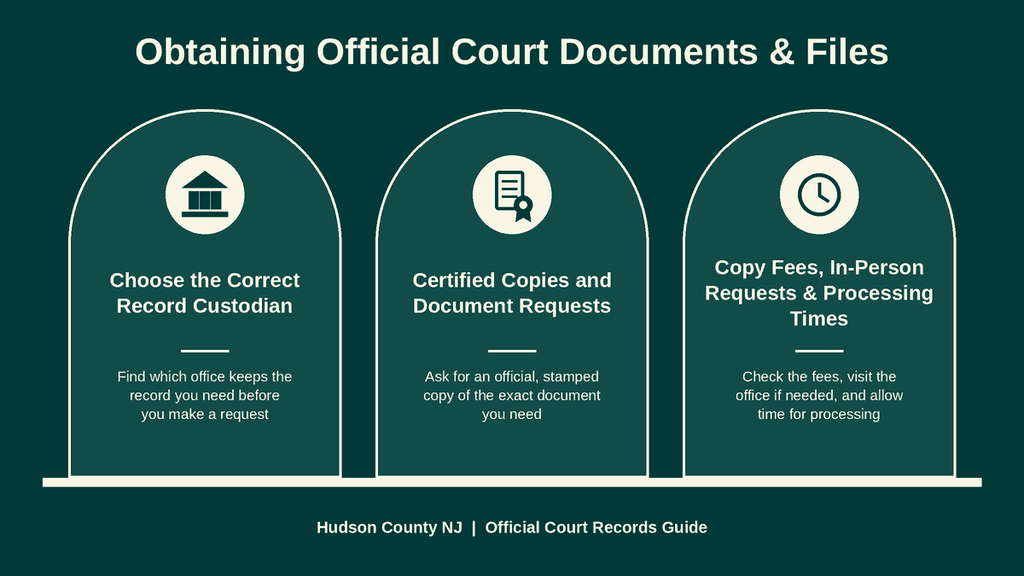
Choose the Correct Record Custodian
A Superior Court criminal file normally comes from the Clerk of the Superior Court. A municipal court file comes from referencing verified court records databases and the clerk of that municipal court County Court and older court labels require a routing check through the Hudson Judiciary office because custody can differ for current and historic records.
The Hudson County Clerk handles county records, but a criminal case should not be sent there merely because the county appears in the caption. County administrative records and criminal court files serve different purposes. Ask the Judiciary contact for the court named on the case to confirm the correct office before visiting or mailing a request.
Certified Copies and Document Requests
A certified copy is an official copy that carries the authentication of the court office. It can carry different legal uses from a printout, scanned image, or ordinary photocopy. Some users need certified proof of a judgment, while others need a full docket sheet, a particular filing, a sentencing order, or a disposition record. Prepare the request with the exact details needed to locate the file. The clerk can confirm any form, identification requirement, payment method, and delivery choice for that court.
- The court name, county, and complete case number.
- The defendant’s name exactly as shown in the case.
- The document title, docket entry number, or date range needed.
- A request for a certified copy, an ordinary copy, or both.
- The preferred delivery method, such as pickup or mail, when the clerk offers that choice.
- The current copy charge, certification charge, and payment method confirmed by the clerk.
- The request form and identification required for an in-person visit.
Ask for a specific document instead of ordering “the whole case” unless you truly need every item. A docket sheet can identify filed documents, while a certified judgment proves the court’s recorded disposition and sentence. The two requests serve different purposes and may carry separate charges.
Copy Fees, In-Person Requests & Processing Times
The total cost can change with the number of pages, whether certification is required, the court receiving the request, and the delivery choice. Ask for a total price after the clerk reviews the document list. Payment methods also vary by office, so confirm whether the court accepts the method you plan to use before traveling or mailing a check.
For an in-person request, bring the case number, the requested document details, the required form, identification, and payment listed by the clerk. A missing case number can slow the search, but do not guess at one. If a name is the only starting point, be ready to supply the court, municipality, date, and charge type.
Ask for a processing estimate at the time of the request. The Hudson listing gives no guaranteed same-day, mail, or electronic-copy timeline. A rush request may have a different fee or may not be offered, so ask about expedited handling rather than assuming it is available. A court transcript is a separate item handled through the court reporting process and is not included merely because a transcript exists in the case file.
Record Accuracy & Search Troubleshooting
A search result can be wrong, incomplete, or linked to a different person with the same name. The search page provides a starting point, while the case number, court, party name, and written court records establish the stronger match. Taking a few extra checks can prevent a request for the wrong file or the wrong document.
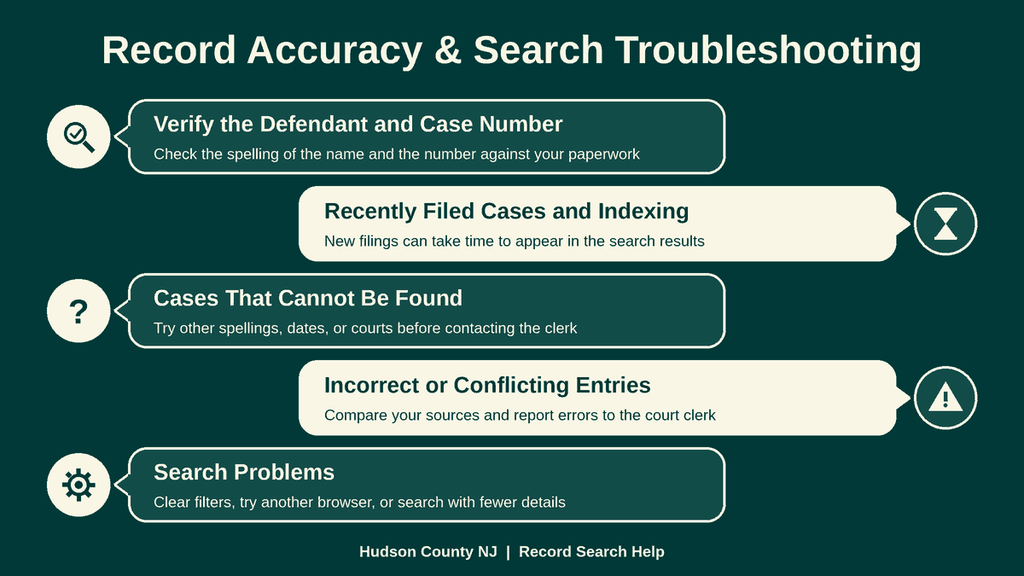
Verify the Defendant and Case Number
Use the defendant’s legal name as it appears on court papers. Names with a middle name, initial, suffix, hyphen, or changed spelling may produce different results. A party-name search can also return cases under a business name, alias, or other party connected with the case, so read the full caption before drawing a conclusion.
Copy the complete case number rather than using only the final digits. Court numbers can include a year, sequence, county, court, or other division marker. Do not confuse the court case number with an attorney number, a municipal complaint number, a traffic point number, or a number used by a third-party search service.
Recently Filed Cases and Indexing
A newly filed case may not appear until the court’s system finishes recording it. The absence of a result soon after filing does not always mean the case was rejected or dismissed. Confirm the filing date and court, then retry with the exact case number and party name after the normal indexing period.
If the case number produces no result but the name does, record the date the entry appeared. If neither search finds the case, contact the court office listed at the end of this page and ask whether the filing has reached the public index. Keep your own filing receipt or court notice for reference.
Cases That Cannot Be Found
A missing result can come from a name mismatch, an incorrect court, a recently filed case awaiting indexing, an older record held outside the public index, a transfer to another court, or a record whose public status has changed. Some sealed, expunged, or otherwise restricted records will not return the same details as an ordinary case.
Search once by the exact case number and once by the party name. Check the court name on the paper instead of guessing from the county. For an older file, include the former court label when asking for help. The clerk can compare the identifier with court indexes and explain the next request process without making a legal claim about whether a record should be public.
Incorrect or Conflicting Entries
If the docket appears to contain a wrong name, number, charge, date, fee, or disposition, save the result and note the exact field that appears wrong. Bring that page, the case number, supporting papers, and identification to the court clerk. A clerical correction and a challenge to the court’s legal decision are separate matters; the clerk can correct a record entry when the court process allows but cannot reverse a judgment by changing a search result.
Ask for the source document behind the entry. A written disposition, judgment, or sentencing order can resolve a conflict between a short docket label and the underlying order. If a correction changes the case data, request a fresh copy of the docket or certified record after the court completes its review.
Search Problems
Contact Details
Use these Judiciary details when you need to confirm a court, identify the proper office for a record request, or ask about a case that does not appear in the statewide search. Call before visiting if you are unsure which court handles the record.
Frequently Asked Questions
Criminal court records give you access to case numbers, defendant names, charges, hearing dates, and final judgments. In Hudson County, the New Jersey Judiciary handles all requests. Knowing how to locate these files helps you verify legal status, prepare for meetings, or research past cases. The steps are simple, and most information is available online at no cost.
How can I search criminal court records in Hudson County?
Start with the New Jersey Trial Court Case Search website. Enter the defendant’s name, case number, or charge. After the results appear, filter by Hudson County and select the Superior Court, Criminal Division. The screen shows filing dates, docket entries, and disposition. Save the PDF or note the docket number for in‑person requests at the Hudson Vicinage office.
What information is included in a criminal docket record?
A docket record lists every filing, hearing, and order in a case. You will see the initial complaint, bail decisions, plea offers, trial dates, and the final judgment. Each entry includes a date, a brief description, and the judge’s signature when applicable. This timeline helps you track case progress and verify outcomes.
Can I find misdemeanor court records the same way as felony records?
Yes. The statewide search covers both misdemeanors and felonies. Use the charge field to specify “misdemeanor” or “felony” if you want to narrow results. The same filtering steps apply, and the docket will clearly label each count as misdemeanor or felony.
What should I do if the online search shows no results for a defendant?
Confirm the spelling of the name and try alternative formats, such as middle initials or suffixes. If the case is older than five years, it may not appear online; call the Hudson County Administration Building at (201) 748‑4400. Request a paper copy by providing the defendant’s full name and, if known, the approximate filing year.
How do I obtain a certified copy of a criminal case judgment?
Visit the Hudson Vicinage clerk’s office during business hours. Bring a valid ID, the docket number, and a small fee (usually $10). Complete the request form, and the clerk will print a certified copy stamped with the court seal. This document is accepted for background checks, employment, or legal filings.